Parameter Estimation via HYPAGS
Aaron Peche & Martin Vonk (2026)
Overview
HYPAGS (HYdraulic Parameters And Grain Sizes) is a parameter estimation method that can estimate full van Genuchten soil hydraulic parameters from minimal input data:
A single saturated conductivity value (k) or representative grain diameters (d10/d20)
This is useful when:
You have measured soil conductivity but no water retention curve
You only have grain size information from grain size analysis
You need a quick estimate but lack the data for pedotransfer functions
Peche, A., Houben, G. and Altfelder, S. (2024), Approximation of van Genuchten Parameter Ranges from Hydraulic Conductivity Data. Groundwater, 62: 469-479. https://doi.org/10.1111/gwat.13365
[1]:
import pedon as pe
Inputs Available for HYPAGS
HYPAGS can work with different types of input data. The method will use whichever measurement is provided.
The accuracy depends on the input type. Conductivity measurements are generally more reliable because they directly affect water movement, while grain size is an indirect proxy.
Example 1: Estimate from Saturated Conductivity
[2]:
# Estimate from saturated conductivity
# Note: HYPAGS expects k in m/s
k_value = 1e-5  # m/s
ss_k = pe.SoilSample(k=k_value)
hyp_k = ss_k.hypags()

print("Estimated van Genuchten parameters from k value:")
print(hyp_k)
Estimated van Genuchten parameters from k value:
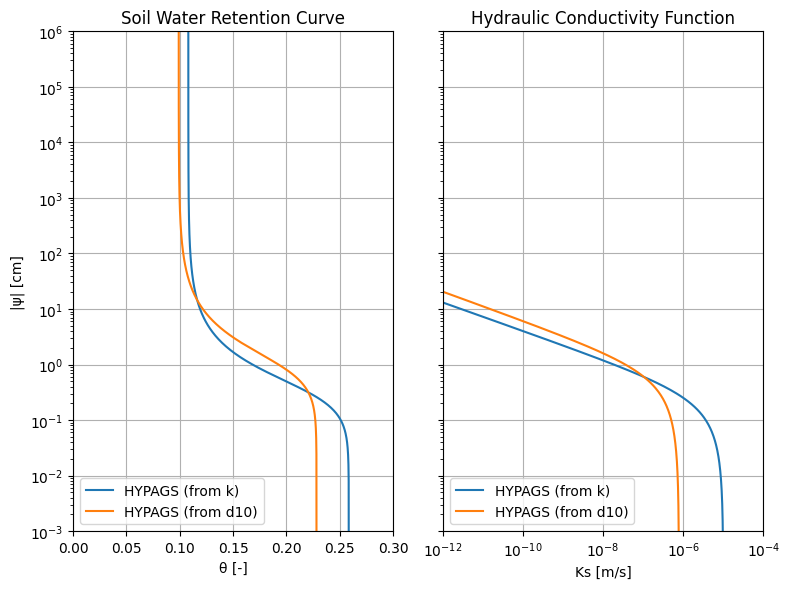
Genuchten(k_s=1e-05, theta_r=0.108, theta_s=np.float64(0.2583863334264952), alpha=np.float64(3.0954271061989362), n=np.float64(1.7620036659998843), l=0.5)
Example 2: Estimate from the Representative D10 Grain Diameter
[3]:
# Estimate from grain diameter
# d10: 10th percentile diameter
d10_value = 1e-5  # m
ss_d10 = pe.SoilSample(d10=d10_value)
hyp_d10 = ss_d10.hypags()

print("Estimated van Genuchten parameters from d10:")
print(hyp_d10)
d10 (1.000e-05) out of hypags model limits: 5.35e-5 to 8.3e-4.
Estimated van Genuchten parameters from d10:
Genuchten(k_s=7.806785158323015e-07, theta_r=0.099, theta_s=np.float64(0.22816361767085197), alpha=np.float64(1.0847731683725947), n=np.float64(1.7288852832248782), l=0.5)
Comparing Results
Let’s visualize how estimates from different inputs compare.
[4]:
axes = pe.plot.curves(hyp_k, label="HYPAGS (from k)")
pe.plot.curves(hyp_d10, axes, label="HYPAGS (from d10)")
axes[0].set_title("Soil Water Retention Curve")
axes[0].set_xlim(-0.01, 0.3)
axes[0].legend()

axes[1].set_title("Hydraulic Conductivity Function")
axes[1].set_xlim(1e-10, 1e-4)
axes[1].set_ylabel("")
axes[1].legend()
[4]:
<matplotlib.legend.Legend at 0x7bafae8b0910>